info-naijatreks@doc.com
- rss
- youtube

Queen of Sheba’s Tomb in Ijebu Ode: For those Who Don’t Believe [Photos]
A site, hidden away in the dense rain forests of south-western Nigeria is believed to be the burial ground of the biblical Queen of Sheba. This burial site is itself located within a large area which is surrounded by the ancient Eredo earthwork and is believed to be the wealthy Queen Sheba’s Lost Kingdom. The small, sleepy village of Oke-Eiri, located on the outskirts of Ijebu Ode, in Ogun State, hosts this burial site of the ancient Queen, and has been the destination of local pilgrims for centuries who come to pay home to the sleeping legend.
Local traditions of the Ijebu people link the Eredo monument to the queen of Sheba (locally called Bilikisu Sungbo). The people believe that Bilikisu was a wealthy, childless widow who ordered her slaves to dig the Eredo for her remembrance. The Ijebu people had since laid claim to her for more than a thousand years and celebrate the Sungbo Eredo festival annually to commemorate the reign of the powerful queen.
The Christian Bible described the queen as a women of immense power, intellect and wisdom, who came to visit King Solomon when she heard of his outstanding wisdom. It was recorded that she came with “a very great caravan of camels, carrying spices, large quantities of gold and precious stones”. It was also stated that “never again where so many spices brought into Israel as those the Queen of Sheba gave to King Solomon”. In Islamic tradition, she is commonly referred to, as Bilkis, Bilqis, Balqis or Balquis by the Arabs, who believe that she came from the city of Sheba, also called Mareb, in Yemen. Historical and archeological studies revealed that there are many links between the Biblical queen and Bilikisu Sungbo of Ijebu land. The Queen of Sheba is said to be associated with ivory, eunuchs and gold. Ivory and gold are known to be very abundant in Nigeria at the time, while eunuchs were present in ancient West African palaces.
In the tradition of the Ijebu people, it is a taboo for women or dogs to visit the tomb of Bilikisu sungbo. It was also said that the burial site of the queen is supernaturally swept clean by the spirit of the Bilikisu.
Our Trip
We departed from Eredo village– where we went to explore a segment of the Eredo monument– around 1:00pm and travelled about an hour, down to Ijebu Ode town. The old town bustled with traffic as clouds of dust rose from the streets and settled on the sun-tanned rust-brown iron roofs. Most of the houses in Ijebu are old. They bear the captivating signatures of ancient Nigeria’s architecture. We passed several round-abouts as we navigated our way to the outskirts of the town and turned into the Ibadan road. At about two kilometers from Ijebu Ode, we branched off the road into a slightly narrower road that leads to Oke-Eiri, the actual home of Queen Sheba’s resting place.
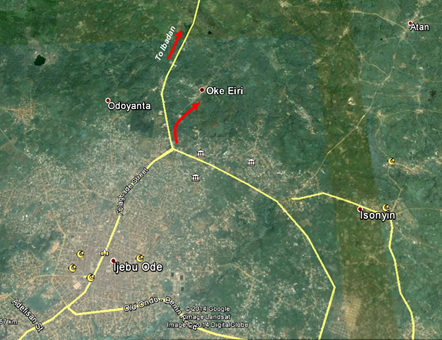 – Google Map of Ijebu Ode, showing the turning to Oke Eiri village.
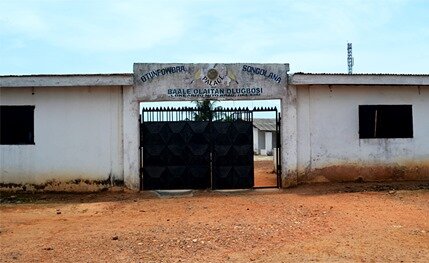
Oke Eiri village is about a kilometer from the Ijebu Ode-Ibadan road. As we entered the village, we immediately perceived a familiar serenity and rusticity, one that is peculiar to remote settlements in Nigeria. The long, white-painted walls palace of the Baale (local governor) of the village stood conspicuous along the road, near the entrance into the village. It had a square arch above its black gate, on which is written “Otunfowora Sangolana Palace, Baale Olaitan Olugbosi”. Two old women sat on a bench just outside the gate, while a younger lady sat on a chair some meters behind them picking lazily at her hair.
Oke-Eiri Baale’s Palace
We pulled over and I walked towards the gate of the palace to make enquiry about Queen of Sheba’s Tomb. The two old women were too busy chatting to notice my presence. The younger lady lifted her head, starred at me with a mild frown and asked who I wanted to see. I walked closer to her and greeted her, requesting to see the Baale. She asked who I am and what I wanted. I told her am a visitor from Lagos who came to see the tomb of Bilikisu Sungbo. She dropped her head, continued picking her hair and said the Baale was sleeping. I stood there. She looked up again and repeated “Baale is sleeping”. I laughed and told her I came with some people, and we can’t go back all the way to Lagos without seeing what we came to Oke Eiri for. She paused for a moment, then turned to the two women who were still busy with their chatter.
“Màámi, e wòó, wón fé wá wo Bilikisu o!” (mama, see, some people are here to see Bilikisu) she said. One of the older women turned towards me and frowned. She asked me who told me that the tomb of Bilikisu is in their village. I smiled and told her it’s been all over the news for years, and that it is no news. She replied and said “well, the tour guide who is meant to take you to the site is not around.”
I couldn’t get the message. I stood there wondering what these people wanted me to do. Do they want me return to Lagos just like that? Are they kidding me? I decided that I wasn’t going to move an inch till I get what I wanted. The mama looked back and asked why I was still waiting. I told her I came all the way from Lagos with my friends, and can’t just go back without achieving our aim. She shook her head and said fine, go there yourself, but you wont be able to see the actual tomb because the gate is locked. I thanked her and asked for the direction to the site. She pointed flimsily up the road that leads into the village and said we should just continue along the road until we see the site on our left. I thanked her again and quickly walked back to the car.
To the Sacred Tomb of Queen of Sheba
We drove through the village, observing the old and rustic buildings, which looked seeming empty except for the bleats of goats and clucking of chicken rummaging through the streets. It was as if most of the villagers had gone to the farm. We got to a cross junction and took a left turn. We had driven a long distance and had begun to transit into a forested area. We decided to stop and asked a villager walking along the road for direction to Bilikisu’s tomb. He shook his head and told us we took a wrong turning. After giving us the right direction to the tomb, we turned round and headed back into the village. We followed the exact direction of the villager and we ended up on the road leading out of the village towards another village called Imope, located deep in the forests. On the outskirt of Oke Eiri, the road splits into two and we took the one on the left, which led us deeper into the forests. We began to wonder if we were on the right track. We saw an old man walking slowly along the narrow road, with a large hoe resting on massive shoulders, eyes bulging out of bony sockets and clothes soiled by the brown earth. We asked him for directions to the tomb and he confirmed that we were on the right track, but that we needed to go further down the road and take another turning to the left before we get to the burial site.
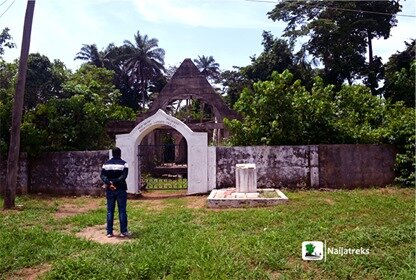
After a few more minutes of driving through the forest, we entered a clearing. A structure stood on our right, nested in the bursting forest. We pulled over and walked closer to the structure. It was a low fence and arch at the middle- all white-washed, and a padlocked blue iron gate set rigidly below the arch. On the arch was boldly written, “HER ROYAL MAJESTY, BILIKISUN SUNGBO, OKE-ERI”. As we read these words, our hearts leapt with joy and despite the accumulated stress of road travelling, trekking through the forested trenches of Eredo and navigating through Oke-Eiri village and forests in search for the tomb site, everyone cheered in relief. Beyond the fence and padlocked gate stood an abandoned, uncompleted structure with a footpath leading through it to its back. We starred through the gate, hoping to see the actual burial ground, but could not make anything of the uncompleted structure. Our hearts burned with zeal and wanderlust.
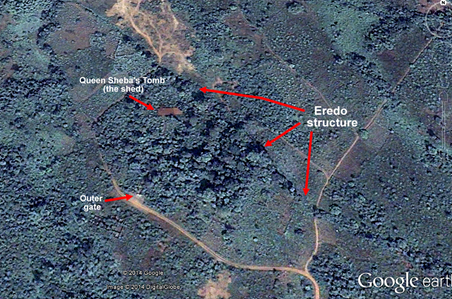
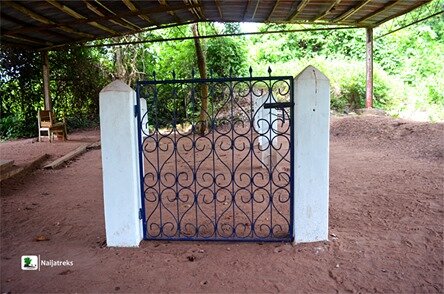
We wouldn’t return home without seeing the sacred burial ground, so we decided to find our way through the barricade. At the back of the uncompleted structure, a footpath springs and snakes into the massive forest. The path covers a distance of 132m through the forest and halts at the foot of an 85ft-long and fairly wide shed, underlain by clean soft sand which is punctuated in most places by tiny funnel-like pits made by doodle bugs. The surroundings stood silent, broken only by the wafts of the green leaves of the enclosing trees. We were overcome by an eerie feeling, an inexplicable feeling of awe and reverence. The shed, which was fenced all around by the towering forest, is made up of a covering of corrugated iron sheets, supported by thick metal columns set in concrete blocks on the bare earth along the edges of the shed. At the extreme end of the shed lies an 8ft-long, 3-5ft wide enclosure on the ground, bounded by series of short white-washed concrete pillars and a short iron gate. The pillars were linked together by four separate rows of iron strings, set in holes through each of the pillars. This enclosed area is the actual burial ground of the fabled Queen of Sheba.
It was reported that in the past, before the shed was constructed over the tomb, a huge spider web, which was woven over thousands of years, formed a thick covering over the grave and prevented dried leaves or dirt from gathering over the burial site. There is a small area, behind the enclosed burial ground, just outside the shed, which appears to be a small clearing. It is said to be the point where the body of the legendary queen was washed before burial and as a result of her spiritual powers, no plant has grown on the spot till this day. Some meters into the forest, behind the shed, traverses a segment of the ancient Eredo monument. This seems to underscore the connection between the burial site and the construction of the Eredo monument.
We returned to Lagos excited and overwhelmed with a sense of fulfillment, having seen the sacred tomb of the legendary Bilikisu Sungbo, the Queen of Sheba, who ruled the ancient Ijebu Kingdom over a thousand years ago.
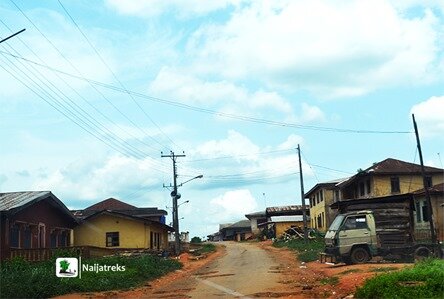 -Oke Eiri village
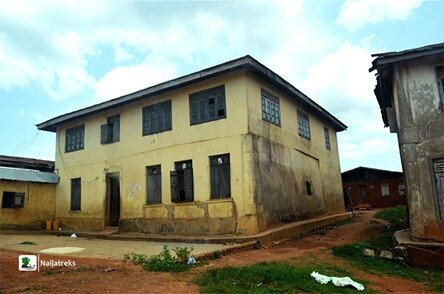 – An old english-styled house in Oke-Eiri
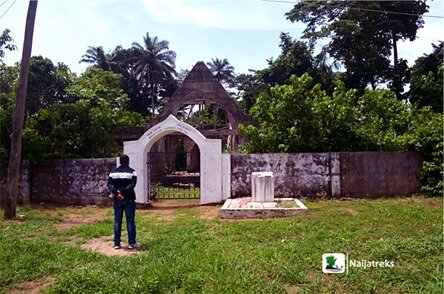 – The outer gate of the sacred tomb of Queen of Sheba.
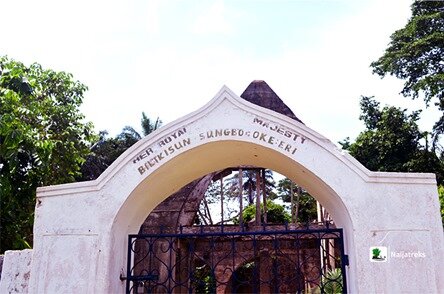 – On the arch was boldly written, “HER ROYAL MAJESTY, BILIKISUN SUNGBO, OKE-ERI”. As we read these words, our hearts leapt with joy and despite the accumulated stress of road travelling, trekking through the forested trenches of Eredo….
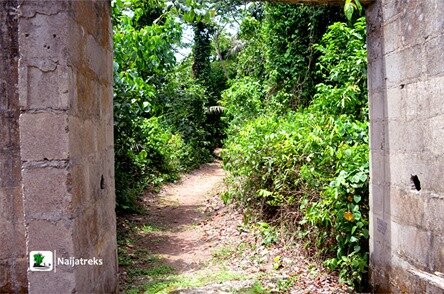 – Beyond the fence and padlocked gate stood an abandoned, uncompleted structure with a footpath leading through it to its back…
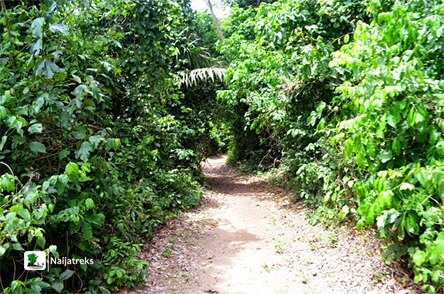 – At the back of the uncompleted structure, a footpath springs and snakes into the massive forest…
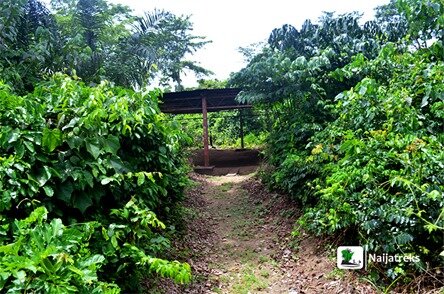 – The path covers a distance of 132m through the forest and halts at the foot of an 85ft-long and fairly wide shed…
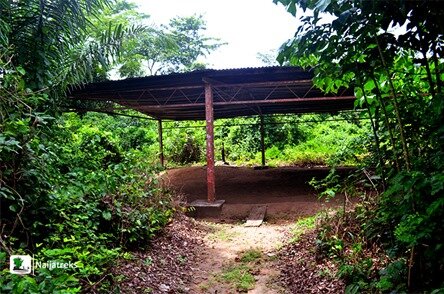
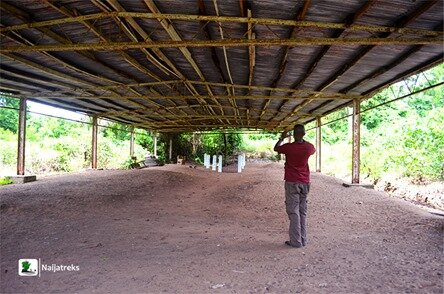
– The 85ft-long and fairly wide shed, underlain by clean soft sand which is punctuated in most places by tiny funnel-like pits made by doodle bugs.
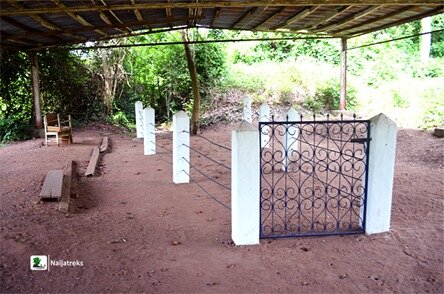
– The grave of the legendary queen of Sheba.
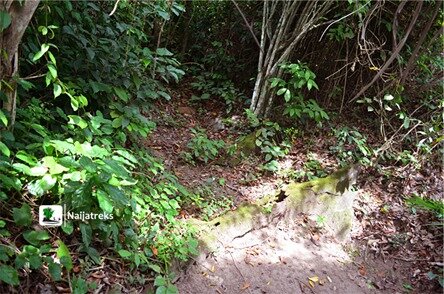 – The area where the body of the legendary queen was washed before burial. As a result of her spiritual powers, no plant has grown on the spot till this day.
Share with friends..


You may also like...
-
 Sungbo’s Eredo in Ijebu Discovered: One of the Largest Archeological Phenomena South of the Sahara Desert
-
 So Much to See in Lagos: Photos from Epe Fish Market, Eredo Moat and Awolowo’s Museum
-
 Olumo Rock- pile of boulders, home of caves, residence of ancient shrines
-
 6 Reasons why you should visit Badagry
-
 The Vernacular Architecture of the Hidden Ancient Irefin Palace, Ibadan, SW Nigeria
-
 Akure Moat: A New Archeological Discovery in Ondo State, Southwest Nigeria?

This article was written by Folarin Kolawole
Founder of Naijatreks, Nigerian-born Folarin Kolawole is a geologist, travel writer and researcher. When not at work, he travels the length and breadth of Nigeria, exploring, taking photos and writing about her numerous hidden tourist potentials. 'Naijatreks' is a product name registered under the Ntreks brand, which is also duly registered by Nigeria's Federal Corporate Affairs Commission. The contents on this blog are re-usable. However, it must be ensured that it is linked back to this blog, and correctly attributed to Naijatreks or the author. Please do not edit, rewrite or commercialize the original works on this blog without direct and written permission from the Founder (Folarin Kolawole). For inquiries and advert placement on the blog, kindly contact us at info-naijatreks@doc.com or naijatreks-doc@gmail.com.
10 comments:
Nigerians shaa…we can just claim anything. Well, it is possible that the queen migrated to West Africa back then. We need more archaeological facts to properly back this up.
The part i dont like about all these is the fact that women are not allowed to visit the tomb…that can kill tourism in such a place.
Correct! I like the fact that you ‘found our thorugh the barricade”.. hahaha
This our country is just so blessed. So many potentials to explore and develop.
I will love 2 visit dis site someday…I am proud to b a nigerian
The eredois from 800-1,000 AD The queen of Sheba lived around 1,000 BC probably in Ethiopia or Yemen, who it’s probably not her tomb, but the monument of an a Yoruba kingdom (early Ijebu perhaps).
[…] click here to view original web page at http://naijatreks.com […]
[…] http://naijatreks.com/2014/05/queen-sheba-tomb/ […]
[…] Oke-Eiri village on the outskirts of Ijebu-Ode town, about one hour (1hr) drive from Eredo, to see the burial site of the legendary Queen of Sheba, known to the locals as Bilikisun […]
I had always believe that the Legendary Queen of Sheba was from Eritrea then part of Ethiopia in East Africa, how come we now have an archeological account to the contrary?
Why would women be placed in same restriction order to the tomb site with dogs? We talking about a queen here and ironically only the male folks are permitted access to a queen’s tomb. Gender inequality in tourism again?
Well I had love to visit that ancestral master piece.