info-naijatreks@doc.com
- rss
- youtube

Naija Tourism, Culture and Games #Ayò-Olópón
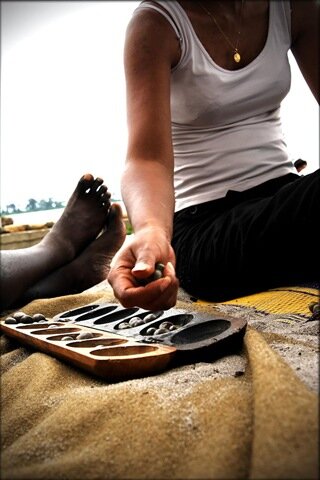
You visit a village in south-western Nigeria and see a group of men standing or sitting beneath the shade of a tree canopy, around two men seated on a bench and facing each other with a wooden board between them- a wooden board incised with two rows of six holes each, containing heaps of green seeds… Sometimes, you even find a big gourd of palm wine reposed on the ground beside them, with cups of its fresh content resting happily in between the laps of the seated men. You can guess what they’re doing. They’re playing the great Ayò Olópón board game.
When I was a little boy, my grandma taught me how to play this game. We had a beautiful board at home back then. The board was made from a strong timber and carved with the figure of an eagle forming its stand. The cover of the board made it possible to use it as a stool when not opened. I loved this game. Unfortunately, I grew up to discover that my generation fancied foreign games, and preferred them to our indigenous games such as the Ayò Olópón. Video games reigned in high schools and universities, and one will likely not have anyone to play with if one dared bring a board game like the Ayò to school.
Back in the days, Ayò Olópón was regarded as a game for elders, and children who played it were presumed as matured and smart. It is also said that the game is played in different places across Africa and can be played with different rules. This is one of the games that connects us back to our ancestors and promotes culture in Nigeria. The Ayò game is a cultural heritage we must revive, this game is a treasure we must keep, and we must teach our children to master.
Thanks to the annual Osun-Oshogbo festival in Osun State, during which the game is played as a major tournament and its winners awarded huge sums of money. There is also news that the game will be incorporated into national sports festivals where contestants will represent their states.
We also have online versions of the Ayo game. They can be played at:
– www.awale.info/joc/en/index.html
– www.alephzero.co.uk/demos/ayo/pebbles.htm
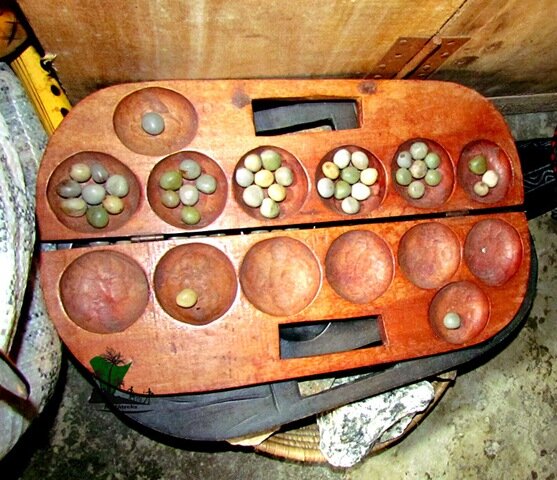 – Ayò Olópón board with its seeds.
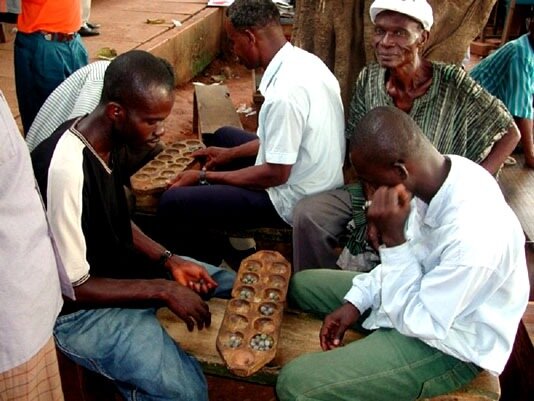 – People playing Ayò game in Kumasi, Ghana (Source).
Share with friends..


You may also like...
-
 Naija Tourism, Culture and Games #Lagos Monopoly
-
 An Aboki’s Craft Shop Reposed in the Chambers of Eko-Hotels and Suites, Lagos
-
 The Lagos You Don’t See: A Whitespace, Ikoyi, where we connected back with an ancient Nigeria
-
 Kill another African Softshell Turtle and you’ve killed another Niger Delta pikin!!!
-
![Nigerians Must begin to Learn the Culture of Wildlife Conservation! Na every Animal for Bush Person dey Kill Chop? [See Photos]](/wp-content/uploads/2014/04/image_thumb1-150x150.png) Nigerians Must begin to Learn the Culture of Wildlife Conservation! Na every Animal for Bush Person dey Kill Chop? [See Photos]
Nigerians Must begin to Learn the Culture of Wildlife Conservation! Na every Animal for Bush Person dey Kill Chop? [See Photos]
-
 Sungbo’s Eredo in Ijebu Discovered: One of the Largest Archeological Phenomena South of the Sahara Desert

This article was written by Folarin Kolawole
Founder of Naijatreks, Nigerian-born Folarin Kolawole is a geologist, travel writer and researcher. When not at work, he travels the length and breadth of Nigeria, exploring, taking photos and writing about her numerous hidden tourist potentials. 'Naijatreks' is a product name registered under the Ntreks brand, which is also duly registered by Nigeria's Federal Corporate Affairs Commission. The contents on this blog are re-usable. However, it must be ensured that it is linked back to this blog, and correctly attributed to Naijatreks or the author. Please do not edit, rewrite or commercialize the original works on this blog without direct and written permission from the Founder (Folarin Kolawole). For inquiries and advert placement on the blog, kindly contact us at info-naijatreks@doc.com or naijatreks-doc@gmail.com.
1 comment:
[…] platforms outside the house where the people could sit on when eating, playing board games such as Ayò-Olópón etc. In addition, the characteristic low roofs of the buildings could have provided shade for the […]